Why Heavy-Duty Protective Coatings Can Lose Adhesion Even When the Paint System Meets Specification
In industrial corrosion protection, coating quality is often evaluated through familiar indicators: primer performance, dry film thickness, salt spray resistance, adhesion testing and topcoat weatherability.
These factors are important. However, they do not tell the entire story.
A manufacturer may use a properly specified epoxy primer, high-build epoxy intermediate coat and polyurethane topcoat. The coating thickness may meet the project requirements, and the application process may appear satisfactory.
Yet after exposure to moisture or outdoor conditions, the coating may develop blistering, localized peeling or loss of adhesion.
Why does this happen?
One possible explanation is hidden contamination on the steel surface before coating application.
Based on more than 20 years of industrial protective coating experience, GranBond emphasizes that long-term coating reliability depends not only on coating formulation but also on the condition of the substrate.
For BESS containers, modular data centers, prefabricated electrical substations and industrial steel structures, this issue deserves particular attention.
Among the potential contaminants are water-soluble salts, including residues that may originate from certain metalworking fluids and temporary corrosion inhibitors.
Understanding these contaminants is an important step in preventing Coating Adhesion Failure.
1. Coating Adhesion Failure Does Not Always Mean Poor Paint Quality

When an industrial coating begins to peel, the first reaction is often to question the paint.
Was the primer defective?
Was the curing agent mixed incorrectly?
Was the coating applied too thin?
These are reasonable questions, but the investigation should not stop there.
A protective coating system relies on several connected factors:
- Substrate condition
- Surface preparation
- Primer adhesion
- Intercoat compatibility
- Correct film thickness
- Appropriate curing
- Environmental exposure
- Application and inspection quality
A weakness in any of these areas may affect the final result.
The Steel–Primer Interface Is Critical
For most conventional protective coating systems, the primer is the first coating layer applied directly to prepared steel.
Its performance depends on establishing a suitable bond with the substrate.
If contamination remains between the steel and primer, the coating may not achieve its intended adhesion.
The problem may remain hidden after application.
The surface can appear smooth and uniform, while the interface underneath contains residues that increase the risk of future failure.
This is why effective corrosion protection begins before the first coat of paint is applied.
Before applying protective coatings, manufacturers should evaluate potential water-soluble contamination on steel surfaces. ISO 8502-6 describes the Bresle method for extracting water-soluble contaminants from steel surfaces, supporting surface cleanliness assessment before industrial coating application.
2. Why Square Steel Tubes and Structural Beams Require Special Attention
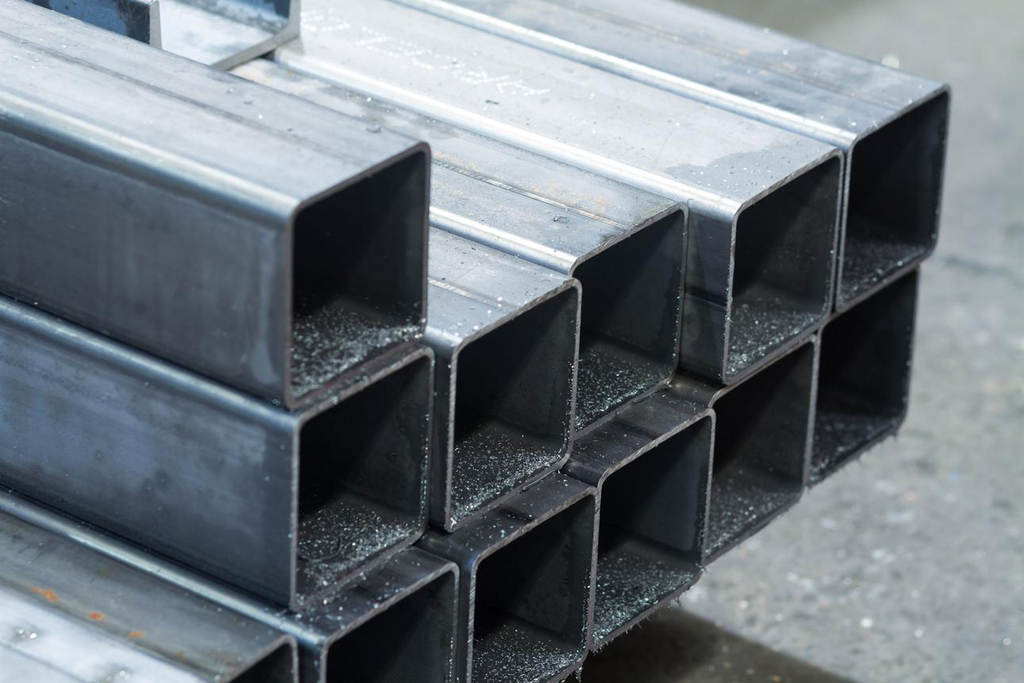
Square hollow sections, rectangular steel tubes and structural beams are widely used in the manufacture of:
- Battery energy storage system containers
- Modular data centers
- Prefabricated electrical substations
- Outdoor electrical equipment enclosures
- Industrial machinery frames
- Other fabricated steel structures
These components may undergo multiple manufacturing operations, including forming, welding, cooling, cutting, storage and temporary corrosion protection.
Depending on the supplier and manufacturing process, water-based cooling fluids, metalworking fluids or temporary rust-preventive treatments may be used.
Some corrosion-inhibiting formulations have historically used sodium nitrite (NaNO₂) as an inhibitor for ferrous metals.
Its purpose in such formulations is to help reduce corrosion during processing, handling or temporary storage.
However, when a treatment is not properly controlled or followed by adequate cleaning, water-soluble residues may remain on the steel.
Why Sodium Nitrite Residue Matters
Sodium nitrite is a water-soluble inorganic salt.
If a relevant residue remains on the surface before coating, it may contribute to contamination at the steel–primer interface.
This can become particularly concerning when the finished equipment operates in humid or wet environments.
However, several important qualifications must be made.
Not all steel tube manufacturers use sodium nitrite.
Not all temporary corrosion inhibitors contain nitrites.
And coating blistering or peeling does not, by itself, prove that sodium nitrite was present.
The actual source and composition of contamination must be established through manufacturing records, appropriate sampling and laboratory analysis.
For manufacturers investigating Coating Adhesion Failure, identifying the contaminant is more useful than assuming a particular chemical is responsible.
3. How Water-Soluble Salts Can Affect Protective Coating Adhesion
Water-soluble salt contamination can affect protective coatings through several mechanisms.
The severity depends on the type and amount of contamination, the coating system, surface preparation and exposure conditions.
3.1 Interference at the Steel–Primer Interface
Epoxy primers require a suitably prepared surface to achieve their intended adhesion.
If salt crystals, processing residues or other contaminants remain on the steel, they may interfere with effective contact between the coating and substrate.
A high-performance primer cannot necessarily compensate for an inadequately cleaned surface.
This risk is particularly relevant to complex steel structures where cleaning and inspection can be difficult.
3.2 Increased Risk of Osmotic Blistering
Certain soluble contaminants trapped beneath a coating may contribute to osmotic blistering.
When moisture penetrates a protective film, soluble material at the interface can create conditions that favor water accumulation.
Under suitable conditions, this may result in blister formation, local loss of adhesion or other coating defects.
The process is not determined by salt concentration alone.
Coating permeability, environmental exposure, substrate condition and the chemical nature of the contaminant also influence the outcome.
Nevertheless, soluble salt contamination is an important potential contributor to premature coating deterioration.
3.3 Underfilm Corrosion and Localized Delamination
If moisture reaches the steel surface, corrosion may develop beneath the coating.
Depending on the coating system and environment, corrosion products and interfacial deterioration may contribute to blistering and delamination.
In coastal and humid industrial environments, the consequences can become more significant.
3.4 Failure of the Complete Multilayer System
A typical heavy-duty protective coating system may include:
| Coating Layer | Primary Function |
|---|---|
| Epoxy Primer | Adhesion and corrosion protection |
| Epoxy Intermediate Coat | Film build and barrier protection |
| Aliphatic Polyurethane Topcoat | Weathering and exterior protection |
Each layer performs a different role.
However, the integrity of the entire system depends partly on the condition of the steel–primer interface.
If that interface is severely compromised, increasing the thickness of the intermediate coat or using a more expensive topcoat may not resolve the underlying problem.
This is a central lesson in preventing Coating Adhesion Failure.
4. Why Solvent Wiping May Not Remove Water-Soluble Salt Contamination
One commonly overlooked issue in industrial coating preparation is the difference between removing oil and removing inorganic salts.
Manufacturers sometimes wipe steel with paint thinner or another organic solvent before coating.
Depending on the solvent and procedure, this can help remove certain oils, greases or organic residues.
However, it does not automatically remove water-soluble inorganic salts.
Oil Contamination and Salt Contamination Are Different
Oil and grease generally require suitable degreasing methods.
Water-soluble salts may require appropriately designed water-based cleaning, rinsing or other validated removal procedures.
A surface can be free of visible oil while still containing soluble contamination.
Therefore:
Solvent degreasing is not equivalent to soluble salt removal.
The same caution applies to other pretreatment processes.
Acid cleaning, phosphating or chemical conversion treatments should not automatically be assumed to remove every possible residue.
Their effectiveness depends on the specific chemistry, process conditions, rinsing procedures and subsequent quality controls.
The Importance of Rinsing and Drying
Where water-based cleaning is used, the process must address:
- Effective removal of the identified contamination
- Adequate rinsing
- Drainage from complex structural details
- Controlled drying
- Prevention of flash rust
- Prevention of secondary contamination
Poorly controlled cleaning can create new problems.
For example, contaminated rinse water may leave additional residues, while inadequate drying may introduce moisture-related risks before priming.
Cleaning procedures should therefore be validated rather than selected solely by convenience.
5. How to Detect and Investigate Hidden Soluble Salt Contamination
Visual inspection is essential, but it cannot identify every chemical contaminant.
Steel may look clean and rust-free while still carrying residues that affect coating performance.
For projects with demanding corrosion protection requirements, manufacturers should consider appropriate surface contamination testing.
Conductivity-Based Surface Salt Testing
Methods associated with ISO 8502-6 and ISO 8502-9 are used in the assessment of water-soluble contamination on prepared steel surfaces.
The Bresle extraction method can collect soluble material from a defined surface area.
Conductivity measurements can then provide an estimate of soluble salt contamination under the specified test procedure.
However, conductivity testing has an important limitation:
It does not identify which individual salts are present.
A conductivity result cannot, by itself, prove the presence of sodium nitrite.
If sodium nitrite or another specific chemical is suspected, an appropriate ion-specific analytical method may be required.
Such testing should be selected with a qualified laboratory.
Investigate the Failure Interface
For an existing coating failure, the investigation may also include:
- Examination of blistered and delaminated areas
- Review of steel supplier and manufacturing records
- Surface contamination analysis
- Coating thickness measurements
- Adhesion testing
- Review of curing and application records
- Assessment of environmental exposure
- Examination of the location and nature of the failure interface
The objective is to identify the actual failure mechanism.
Coating adhesion testing is valuable, but the result must be interpreted alongside the observed failure mode and other evidence.
A single test rarely explains every cause of a complex coating failure.
Establish Project-Specific Acceptance Criteria
There is no single soluble salt limit that can automatically be applied to every steel structure and coating system.
Acceptance criteria should follow the relevant project specification, coating manufacturer requirements and applicable technical standards.
The required level of control may vary with the service environment and intended coating performance.
6. How BESS Container and Modular Equipment Manufacturers Can Prevent Coating Adhesion Failure
Prevention is usually more efficient than repairing coating defects after production.
For manufacturers of energy storage containers, modular data centers and prefabricated electrical equipment, GranBond recommends a coordinated approach.
Step 1: Review Steel Supplier Processing Methods
Understand how square tubes, rectangular sections and structural members are manufactured and protected before delivery.
Where relevant, ask whether water-based metalworking fluids or temporary corrosion inhibitors are used.
If a suspected residue is associated with a particular batch, review the supplier’s process records and chemical information.
Step 2: Do Not Rely on Visual Cleanliness Alone
A bright, rust-free steel surface is not necessarily free of chemical contamination.
For critical coating applications, evaluate whether soluble salt testing is required.
Use documented acceptance criteria appropriate to the project.
Step 3: Match Cleaning Methods to Contamination Types
Oil, grease, dust, rust and water-soluble salts are different forms of contamination.
Each may require different preparation methods.
Where soluble salts are identified, use a validated removal procedure and confirm the effectiveness of cleaning.
Step 4: Control Drying and Recontamination
After cleaning, ensure the steel is adequately dried before primer application.
Control substrate temperature, ambient humidity and dew point conditions according to the coating specification.
Avoid prolonged exposure of prepared steel to conditions that could cause flash rust or renewed contamination.
Step 5: Verify the Complete Coating System
Before large-scale production, consider coating trials on representative production steel.
The evaluation may include adhesion, coating appearance, dry film thickness and other relevant performance tests.
Where a manufacturing process changes, revalidation may be necessary.
Step 6: Establish Traceability and Corrective Action Procedures
If abnormal coating performance is detected, record:
- Steel supplier and batch
- Manufacturing and pretreatment history
- Cleaning procedures
- Coating product batches
- Application conditions
- Inspection results
- Failure observations and analytical findings
This information helps manufacturers distinguish material issues from preparation, application and exposure-related causes.
A structured investigation can prevent repeated Coating Adhesion Failure across multiple production batches.
Steel Surface Contamination: A Practical Quality Control Checklist
| Production Stage | Potential Risk | Recommended Control |
|---|---|---|
| Steel Procurement | Unknown temporary corrosion inhibitor residues | Review supplier processing information |
| Incoming Inspection | Invisible surface contamination | Apply risk-based inspection and testing |
| Degreasing | Oil removal mistaken for salt removal | Match cleaning method to contaminant |
| Water-Based Cleaning | Incomplete rinsing or residual salts | Validate cleaning and rinsing effectiveness |
| Drying | Trapped moisture or flash rust | Control drainage, drying and exposure |
| Surface Preparation | Remaining contamination or unsuitable profile | Verify specified surface condition |
| Primer Application | Weak steel–primer interface | Follow coating application requirements |
| Quality Inspection | Failure mechanism not identified | Combine adhesion testing with contamination analysis |
These controls should be integrated into the manufacturing quality plan rather than treated as isolated corrective actions.
Why Surface Contamination Matters for Long-Term Corrosion Protection
For BESS containers and modular industrial equipment, corrosion protection is often discussed in terms of coating thickness, salt spray testing and outdoor durability.
These indicators are important, but they cannot compensate for a contaminated substrate.
A protective coating system begins with the steel itself.
If a water-soluble residue remains beneath the primer, the resulting risk may not be visible during initial inspection.
The coating may appear acceptable when the equipment leaves the factory.
Problems may only become apparent after exposure to humidity, condensation or other environmental conditions.
This does not mean that every coating failure is caused by soluble salts.
Poor surface preparation, inadequate curing, incompatible materials, environmental conditions and mechanical damage are also possible causes.
The key is to investigate systematically.
For manufacturers seeking long-term reliability, coating quality control should extend from steel procurement and fabrication through cleaning, coating application and final inspection.
Frequently Asked Questions
Can sodium nitrite residue cause coating adhesion problems?
Residual sodium nitrite is one possible source of water-soluble contamination in certain steel processing environments. If present at a problematic level beneath a coating, it may contribute to interfacial deterioration. Its presence and role in a specific failure must be confirmed through appropriate testing.
Do all square steel tubes contain sodium nitrite?
No. Steel tube manufacturing and temporary corrosion protection processes vary by supplier. Sodium nitrite should not be assumed to be present without supporting evidence.
Can paint thinner remove soluble salts from steel?
Ordinary organic solvent wiping is generally not a reliable method for removing water-soluble inorganic salts. An appropriate, validated cleaning process should be selected based on the contaminant.
Can abrasive blasting remove all soluble salt contamination?
Not necessarily. Abrasive blasting is important for removing rust and creating a suitable surface profile, but it should not automatically be treated as proof that soluble salts have been removed to the required level.
How can manufacturers test steel for soluble salt contamination?
Suitable extraction and conductivity-based methods can be used to assess soluble contamination. Identifying a specific ion, such as nitrite, requires an appropriate analytical method.
Does high salt spray resistance guarantee good coating adhesion?
No. Salt spray exposure and adhesion testing evaluate different aspects of coating performance. Neither replaces proper surface preparation and substrate contamination control.
GranBond: More Than 20 Years of Industrial Corrosion Protection Experience
GranBond specializes in heavy-duty protective coatings for demanding industrial environments.
With more than 20 years of industry experience, we provide epoxy primers, epoxy intermediate coatings, polyurethane topcoats and compatible protective coating systems for:
- Battery energy storage containers
- Modular data centers
- Prefabricated electrical equipment
- Industrial steel structures
- Commercial vehicles
- Marine and offshore applications
Our approach to protective coating performance goes beyond paint selection.
We recognize the importance of substrate preparation, coating compatibility, film thickness control, application conditions and quality inspection.
For manufacturers experiencing unexpected coating blistering, peeling or adhesion problems, identifying the underlying cause is essential before selecting corrective measures.
Protect Your Coating System from the Steel Surface Up
Reliable corrosion protection does not begin with the topcoat.
It begins with understanding the substrate.
Contact GranBond to discuss protective coating selection, steel surface preparation and coating application requirements for your industrial equipment.
GranBond — BUILT FOR HARSH ENVIRONMENTS.