More Coating Thickness Does Not Automatically Mean Better Protection
When specifying a heavy-duty protective coating system, Dry Film Thickness is one of the most important parameters used to control coating quality.
A common assumption is simple:
If a 100 μm coating provides good corrosion protection, applying 150 μm or 200 μm must provide even better protection.
But industrial coatings do not always work this way.
Insufficient film thickness can certainly reduce barrier protection and expose the substrate to premature corrosion. However, excessive coating thickness can also introduce problems such as solvent entrapment, internal stress, cracking, poor curing, and reduced intercoat performance.
The objective is therefore not to apply the thickest possible coating.
It is to achieve the correct Dry Film Thickness specified for the coating system.
1. What Is Dry Film Thickness?

Dry Film Thickness, commonly abbreviated as DFT, is the thickness of a coating remaining on the substrate after the coating has dried or cured.
It is normally expressed in:
Micrometers (μm / microns)
or
Mils
DFT is different from Wet Film Thickness (WFT), which measures the coating immediately after application while solvents or water are still present.
For protective coatings, DFT is important because it directly influences:
- Barrier protection
- Corrosion resistance
- Mechanical performance
- Coating appearance
- Material consumption
- Long-term durability
Every coating product is designed to perform within a recommended film thickness range.
2. What Happens When Dry Film Thickness Is Too Low?
If Dry Film Thickness is below the specified range, the protective barrier may become insufficient.
Thin areas can create weak points where moisture, oxygen, salts, and other corrosive substances can reach the substrate more easily.
Possible consequences include:
- Reduced corrosion resistance
- Premature rust formation
- Uneven protection
- Poor coverage of surface profile peaks
- Reduced service life
- Inconsistent appearance
This is particularly important on abrasive-blasted steel.
The surface is not perfectly flat. It contains microscopic peaks and valleys created by blasting.
If insufficient coating is applied, the highest peaks may receive inadequate coverage, creating potential weak points in the protective system.
Accurate Dry Film Thickness measurement is an important part of coating quality control. International standards such as ISO 19840 provide procedures for measuring and accepting the thickness of protective coating systems applied to rough steel surfaces.
3. Why Excessive Dry Film Thickness Can Also Cause Problems
It is tempting to assume that additional paint provides additional safety.
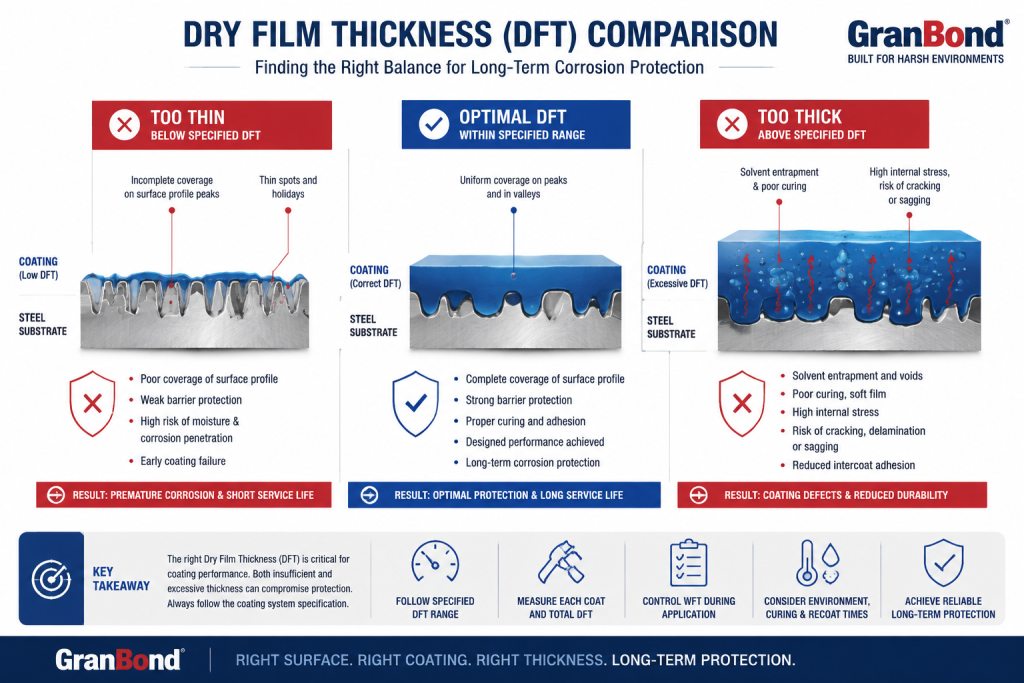
However, exceeding the recommended Dry Film Thickness can negatively affect coating performance.
Depending on the coating chemistry and application conditions, excessive thickness may contribute to:
Solvent Entrapment
When a solvent-borne coating is applied too heavily, the surface may begin to form a film before solvents deeper inside the coating have escaped.
This can interfere with proper curing.
Internal Stress
As coatings cure, they can develop internal stresses.
Excessively thick films may increase stress within the coating and potentially contribute to cracking or loss of adhesion.
Sagging
Applying too much wet paint in a single coat can cause the coating to flow downward before sufficient curing occurs.
Extended Curing Time
Thicker films may require more time for solvent release and complete curing.
Intercoat Problems
If one layer does not cure correctly, the adhesion and performance of subsequent layers may also be affected.
Therefore:
More paint does not necessarily mean more protection.
4. Dry Film Thickness Must Match the Coating Type
Different coating layers perform different functions, so they do not require the same film thickness.
For example, a heavy-duty protective coating system may include:
| Coating Layer | Example Typical DFT | Primary Function |
|---|---|---|
| Epoxy Zinc-Rich Primer | 60–80 μm | Corrosion protection and adhesion |
| Epoxy Primer | 60–80 μm | Barrier protection and adhesion |
| Epoxy MIO Intermediate | 100–150 μm | High-build barrier protection |
| Truck Topcoat | 50–60 μm | Weather resistance and appearance |
| PU / Protective Topcoat | 40–60 μm | UV and weather protection |
These values are illustrative system examples rather than universal specifications. Actual DFT should follow the relevant product TDS and project specification.
A primer should not simply be applied at intermediate-coat thickness, nor should a topcoat automatically be made thicker in an attempt to increase corrosion protection.
Each layer has a specific function within the complete system.
5. Total DFT and Individual Coat DFT Are Both Important
Another common mistake is checking only the final total coating thickness.
Imagine a three-layer coating system designed as:
Primer → 70 μm
Intermediate Coat → 120 μm
Topcoat → 50 μm
Total:
240 μm DFT
Now imagine the final measurement still shows approximately 240 μm, but the actual distribution is:
Primer → 35 μm
Intermediate Coat → 155 μm
Topcoat → 50 μm
The total thickness appears correct.
But the coating system is not necessarily equivalent.
The primer may no longer provide the intended substrate coverage, while the intermediate layer may be significantly above its intended thickness.
This is why quality control should consider both:
Individual Coat Thickness + Total System Thickness
rather than relying only on the final number.
Long-term corrosion protection depends on more than coating thickness alone. Proper surface preparation, coating selection, application control, inspection, and environmental conditions should be considered as part of the complete protective coating system. AMPP provides industry resources and technical guidance for protective coatings and corrosion control.
6. Surface Profile Affects DFT Measurement and Protection
The previous GranBond article discussed why steel surface preparation is critical before coating application.
Surface profile also has a direct relationship with Dry Film Thickness.
After abrasive blasting, steel develops peaks and valleys.
The coating must adequately cover this profile while maintaining the required protective film.
Therefore, coating specifications should consider:
- Surface profile
- Primer thickness
- Measurement method
- Coating solids
- Application technique
A coating applied over an excessively rough profile may require more material simply to achieve sufficient coverage.
This demonstrates why:
Surface Preparation and Dry Film Thickness should never be considered separately.
7. Wet Film Thickness Helps Control Final DFT
Waiting until the coating is completely cured before discovering a film-thickness problem can create expensive rework.
One useful application-control method is measuring Wet Film Thickness (WFT) during spraying.
A simplified relationship is:
Expected DFT ≈ WFT × Volume Solids
For example, if a coating has approximately 60% volume solids and is applied at:
100 μm WFT
the theoretical DFT would be approximately:
60 μm
Actual results can vary due to application conditions, surface profile, thinning, measurement method, and other factors.
Nevertheless, WFT measurement gives applicators immediate feedback during spraying and can help maintain more consistent coating thickness.
8. How Is Dry Film Thickness Measured?
After the coating has sufficiently dried or cured, DFT can be measured using a coating thickness gauge.
For coatings applied to steel, non-destructive electronic or magnetic gauges are commonly used.
A good inspection process should include measurements at multiple locations rather than relying on a single reading.
This helps identify:
- Thin spots
- Excessively thick areas
- Application inconsistency
- Differences around edges and complex geometries
Measurement equipment should also be properly calibrated or verified according to the applicable inspection procedure.
For large structures such as BESS containers, truck bodies, modular equipment, and marine structures, systematic DFT inspection is an important part of coating quality control.
9. Complex Structures Require More Attention to Film Thickness
Maintaining uniform Dry Film Thickness becomes more difficult when coating complex structures.
Typical examples include:
- Weld seams
- Sharp edges
- Corners
- Bolts
- Reinforcement ribs
- Tubular frames
- Narrow spaces
- Complex container structures
Edges and welds can be particularly vulnerable because coating distribution may differ from large flat surfaces.
For demanding applications, stripe coating may be specified around critical areas before the full coat is applied.
This provides additional protection where achieving uniform coverage is more difficult.
10. DFT Should Be Designed Around the Entire Coating System
A professional protective coating specification should consider much more than one target thickness number.
The final performance depends on the interaction between:
Surface Preparation
↓
Surface Profile
↓
Primer Selection
↓
Dry Film Thickness
↓
Intermediate Coat
↓
Topcoat
↓
Application & Inspection
↓
Service Environment
A coating system is only as reliable as the complete process used to create it.
This is especially important for industrial assets expected to operate outdoors for many years.
Dry Film Thickness for Different Industrial Applications
Battery Energy Storage Systems (BESS)
DFT control helps provide consistent corrosion protection across large container surfaces, frames, welds, and structural components.
Modular Data Centers
Consistent coating thickness contributes to long-term protection for outdoor modular structures and equipment enclosures.
Marine & Offshore Equipment
Severe corrosive environments require carefully specified coating systems where DFT forms part of the overall corrosion protection strategy.
Heavy Trucks and Trailers
Film thickness must balance corrosion protection with appearance, impact performance, production efficiency, and curing requirements.
Industrial Steel Structures
DFT should be selected according to the corrosivity environment, coating system, expected durability, and project specification.
Frequently Asked Questions
What is Dry Film Thickness?
Dry Film Thickness is the thickness of a coating remaining on a substrate after drying or curing. It is commonly measured in micrometers or mils.
Does a thicker coating provide better corrosion protection?
Not always. Insufficient thickness can reduce protection, but excessive thickness can also cause problems depending on the coating, including solvent entrapment, cracking, sagging, curing problems, or internal stress.
What is the correct DFT for an epoxy primer?
There is no universal value. Many industrial epoxy primers are designed around a specified thickness range, but the correct DFT must follow the product’s Technical Data Sheet and project requirements.
What is the difference between WFT and DFT?
WFT is the thickness immediately after coating application. DFT is the thickness remaining after the coating has dried or cured.
Should I measure each coat or only the total DFT?
For quality-critical protective coating systems, monitoring individual coating layers as well as total system thickness provides better process control.
Conclusion
Dry Film Thickness is one of the most important quality-control parameters in industrial protective coating applications.
Too little coating can result in insufficient barrier protection and premature corrosion.
Too much coating can also create performance and application problems.
The goal is not:
“Apply as much paint as possible.”
The correct approach is:
Apply the right coating, at the right thickness, over the right surface, under the right application conditions.
For BESS containers, modular equipment, commercial vehicles, marine structures, and industrial steel assets, proper DFT control helps the complete coating system achieve its intended performance and service life.
About GranBond
GranBond develops industrial protective coating systems for demanding applications including BESS, modular equipment, commercial vehicles, marine and offshore structures, and industrial steel assets.
Our technical approach considers the complete coating process—from surface preparation and coating selection to film thickness, application, and long-term environmental exposure.
GranBond — BUILT FOR HARSH ENVIRONMENTS.
Need Help Determining the Right Coating Thickness?
GranBond can recommend coating systems based on your:
- Substrate
- Corrosion environment
- Surface preparation
- Application process
- Required service life
- Production requirements
