Introduction
With the rapid growth of renewable energy and battery storage technology, Battery Energy Storage Systems (BESS) are being deployed worldwide.
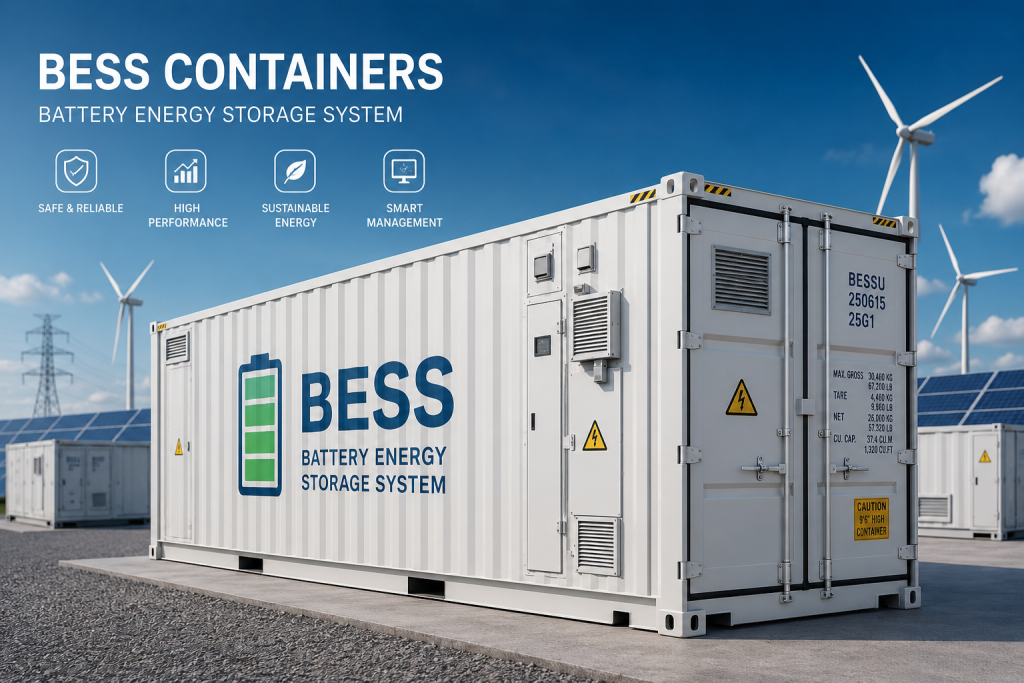
From utility-scale solar farms to industrial energy storage projects, thousands of energy storage containers are operating in:
- Coastal regions;
- Desert environments;
- Tropical climates;
- Industrial areas.
These environments expose steel container structures to:
- Salt spray;
- High humidity;
- UV radiation;
- Temperature fluctuations;
- Chemical pollutants.
In a complete BESS Container Coating System, epoxy primer, intermediate coat and polyurethane topcoat work together to provide long-term protection.
For these applications, a high-performance BESS Container Coating System is essential.
However, many project owners focus mainly on:
- Salt spray hours;
- Coating thickness;
- Paint specifications.
While these parameters are important, one critical factor is often underestimated:
Surface preparation before coating application.
A coating system can only perform as well as the surface it is applied to.
A reliable BESS Container Coating System is not only about passing salt spray tests, but about maintaining coating integrity during 10–15 years of outdoor exposure.
1. Why Surface Preparation Is the Foundation of Corrosion Protection
Steel surfaces naturally contain:
- Mill scale;
- Rust;
- Dust;
- Oil contamination;
- Moisture;
- Surface salts.
If these contaminants are not properly removed, the coating cannot form a strong bond with the steel substrate.
Even a premium epoxy primer and polyurethane topcoat may fail prematurely if the surface preparation is insufficient.
Typical coating failures caused by poor surface preparation include:
- Coating peeling;
- Blistering;
- Rust under coating;
- Loss of adhesion;
- Premature corrosion.
Therefore, surface preparation is not simply a preparation step.
It is the foundation of the entire protective coating system.
2. Sa 2.5 Surface Preparation for Heavy-Duty Coating Systems
For high-performance industrial coating applications, especially C5 corrosion environments, abrasive blasting is commonly required.
A widely accepted standard is:
Sa 2.5 Near White Metal Blast Cleaning
This process removes:
- Rust;
- Mill scale;
- Surface contaminants.
It creates:
- Clean steel surface;
- Suitable surface profile;
- Improved coating adhesion.
For BESS containers, modular data centers and industrial equipment, Sa 2.5 surface preparation helps ensure:
- Strong primer adhesion;
- Better coating durability;
- Reduced corrosion risk.
According to ISO 8501-1, abrasive blast cleaning grades are internationally recognized for evaluating steel surface cleanliness before protective coating application. Proper surface preparation helps ensure coating adhesion and long-term corrosion protection.
3. Surface Profile: The Hidden Factor Behind Coating Adhesion
Many people focus on coating thickness but overlook another important parameter:
Surface Profile
After blasting, the steel surface develops microscopic roughness.
This roughness allows coating materials to mechanically anchor into the steel surface.
If the profile is too low:
- Adhesion strength decreases;
- Coating may peel.
If the profile is too high:
- More coating material is required;
- Surface peaks may remain insufficiently protected.
Therefore, controlling surface profile is important for achieving a balanced coating system.
4. Clean Steel Does Not Always Mean Ready-to-Coat Steel
After blasting, steel surfaces must also be controlled carefully.
Important factors include:
Surface Dust
Dust particles can create weak points between coating and steel.
Surface Salt Contamination
Chloride contamination is especially dangerous in coastal environments.
It can cause:
- Under-film corrosion;
- Blistering;
- Coating failure.
Flash Rust
If blasted steel is exposed to moisture before coating application, flash rust may develop.
Therefore, professional coating processes require control of:
- Surface cleanliness;
- Environmental humidity;
- Steel temperature;
- Dew point conditions.
5. Surface Preparation and Coating System Must Work Together
A reliable BESS container coating system is not based on one product.
It is a complete system:
Step 1: Surface Preparation
- Abrasive blasting;
- Cleaning;
- Profile control.
↓
Step 2: Epoxy Primer
Provides:
- Strong adhesion;
- Corrosion resistance;
- Base protection.
↓
Step 3: Epoxy Intermediate Coat
Provides:
- Additional film build;
- Barrier protection;
- Reduced moisture penetration.
↓
Step 4: Aliphatic Polyurethane Topcoat
Provides:
- UV resistance;
- Weather durability;
- Color retention;
- Long-term appearance.
6. Why Good Paint Cannot Fix Poor Surface Preparation
A common misunderstanding in industrial coating projects is:
“Using a better coating product can compensate for poor surface preparation.”
However, coating performance depends on the complete system.
A premium coating applied on poorly prepared steel may fail earlier than a standard coating applied on a properly prepared surface.
The real performance comes from:
Surface Preparation + Coating System + Application Quality
All three factors must work together.
7. Surface Preparation for Different Global Environments
Different regions require different coating considerations.
Coastal Areas
Main challenges:
- Salt spray;
- Chloride contamination;
- High humidity.
Focus:
- Surface salt control;
- High barrier coating systems.
Middle East
Main challenges:
- Strong UV;
- High temperature;
- Dust contamination.
Focus:
- Weather-resistant topcoat;
- Thermal stability.
Southeast Asia
Main challenges:
- High humidity;
- Condensation;
- Tropical corrosion.
Focus:
- Moisture resistance;
- Strong adhesion.
Conclusion
For BESS containers, modular data centers and outdoor industrial equipment, corrosion protection does not begin with the paint.
It begins with the steel surface.
A reliable BESS Container Coating System requires:
✓ Proper surface preparation
✓ Controlled blasting quality
✓ Strong coating adhesion
✓ Compatible primer and topcoat system
✓ Correct application conditions
Long-term corrosion protection is not achieved by simply increasing coating thickness or choosing the most expensive product.
It is achieved through a complete engineering approach.
For equipment expected to operate outdoors for 10–15 years or longer, surface preparation is the first and most important step toward reliable protection.
Long-term corrosion protection for BESS containers should be designed based on environmental exposure categories and coating system performance. The ISO 12944 standard provides guidance for selecting protective coating systems for steel structures exposed to different atmospheric conditions.