When discussing corrosion protection for data centers, emergency power systems, battery energy storage systems (BESS), and other outdoor modular industrial equipment, most attention is usually given to two coating layers.
The first is the primer.
Because the primer is applied directly to the steel substrate, it plays an important role in adhesion and initial corrosion protection.
The last is the topcoat.
Because the topcoat is directly exposed to sunlight, rain, humidity, temperature changes and atmospheric contaminants, it contributes to weather resistance, color retention, gloss retention and final appearance.
But between these two layers is another critical protective barrier that is often overlooked:
the epoxy intermediate coat.
In a heavy-duty protective coating system, an Epoxy Intermediate Coat is not simply an additional layer of paint. It can help build dry film thickness, improve barrier protection, provide mechanical durability and create a stable transition between the primer and topcoat.
For outdoor industrial assets expected to operate for many years, this middle layer can play an important role in the performance of the entire corrosion protection system.
1. Corrosion Protection Is a System, Not a Single Paint
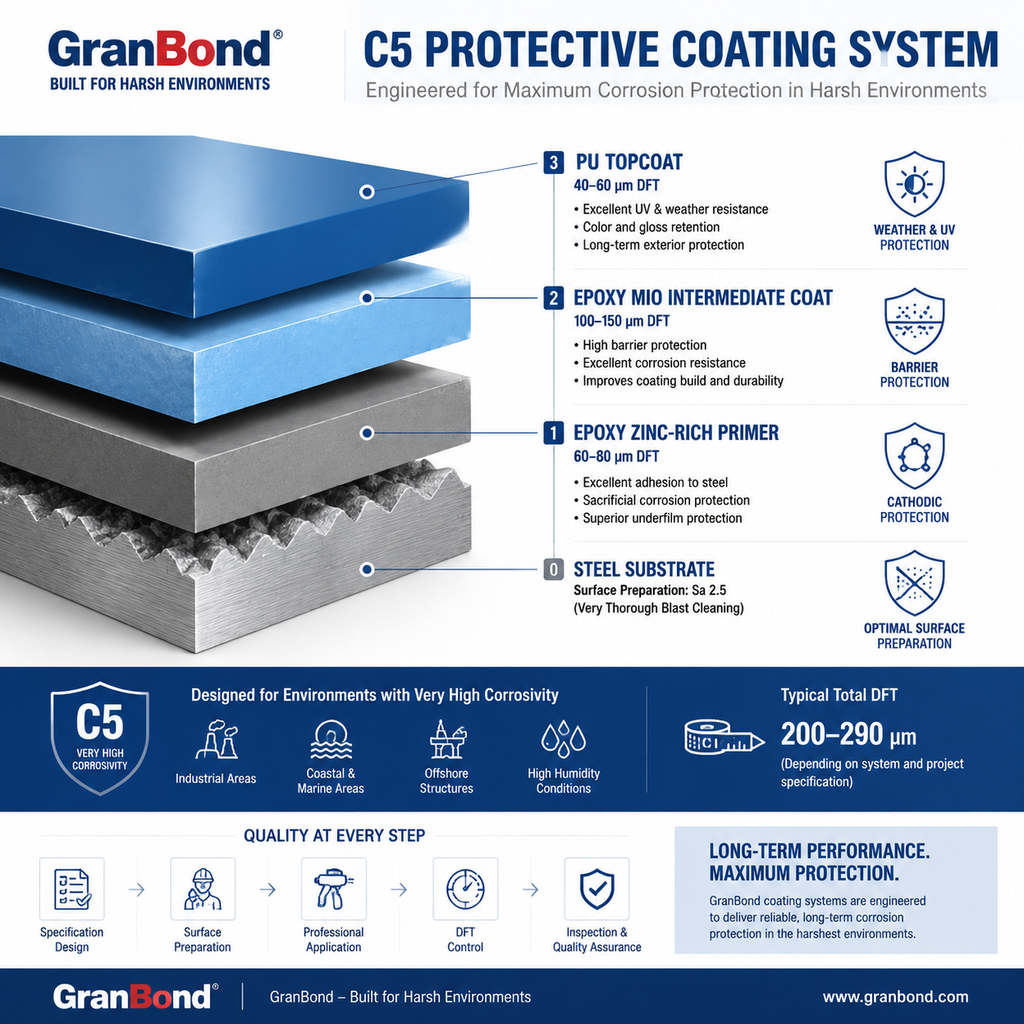
A reliable heavy-duty corrosion protection system should not be evaluated by looking at only one coating layer.
Each layer performs a different function.
The primer establishes adhesion to properly prepared steel and provides the first stage of corrosion protection.
The topcoat faces the external environment and provides weather resistance, UV resistance, color retention and appearance.
Between them, the Epoxy Intermediate Coat helps connect the complete system while providing additional barrier protection and film build.
A typical three-coat protective system can therefore be understood as:
Steel Substrate
↓
Primer — Adhesion & Corrosion Protection
↓
Epoxy Intermediate Coat — Film Build & Barrier Protection
↓
Topcoat — UV & Weather Resistance
Rather than asking which individual paint is the “best,” engineers should consider how these layers work together.
Long-term protection depends on a chain of performance:
Adhesion + Corrosion Protection + Barrier Performance + DFT + Mechanical Durability + Weather Resistance
A serious weakness in one part of this chain can compromise the performance of the entire coating system.
A reliable corrosion protection strategy should be based on the complete coating system rather than the performance of a single layer. ISO 12944-5 provides guidance on protective paint systems for steel structures and their selection for different environments.
2. The Intermediate Coat Helps Build the Required DFT
Dry Film Thickness (DFT) is an important parameter in heavy-duty protective coating systems.
For water, oxygen, chlorides and other corrosive species to reach the steel substrate, they must first penetrate or find a path through the protective coating system.
Within an appropriately designed specification, sufficient DFT helps create a more substantial physical barrier between the environment and the steel.
One important function of an Epoxy Intermediate Coat is therefore to build the required system thickness efficiently.
This is particularly relevant when protecting equipment exposed to:
- High humidity
- Coastal atmospheres
- Salt-containing environments
- Industrial pollution
- Frequent condensation
- Long-term outdoor exposure
This is also why heavy-duty corrosion protection should not always be simplified to:
“Apply a good primer and then apply a good topcoat.”
For demanding outdoor environments, the complete coating architecture matters.
An intermediate coat can provide additional film build without requiring the primer or more expensive weather-resistant topcoat to perform every function.
However, DFT must remain within the coating manufacturer’s recommended specification. More thickness does not automatically mean better protection.
3. Good Barrier Protection Requires More Than Thickness
Film thickness alone does not determine corrosion resistance.
The quality and continuity of the coating film are equally important.
Water, oxygen and dissolved corrosive ions can contribute to corrosion processes when they reach susceptible areas of the steel substrate.
A well-formulated Epoxy Intermediate Coat should therefore contribute to a continuous and effective barrier within the overall system.
One way to understand this is:
DFT determines how substantial the barrier is, while film integrity influences how effectively that barrier performs.
A thick coating containing application defects, poor intercoat adhesion, pinholes or other discontinuities may not provide the expected level of protection.
This is why long-term corrosion protection should not be judged only by:
Topcoat weatherability
or
Primer salt spray performance.
The barrier properties and integrity of the complete coating system also matter.
For BESS containers, modular data centers and outdoor power equipment, this becomes increasingly important when equipment is installed in humid, coastal or industrial environments.
4. An Epoxy Intermediate Coat Should Not Simply Be “As Hard As Possible”
Outdoor industrial equipment does not remain completely stationary throughout its life.
Before reaching the installation site, modular equipment may experience:
Manufacturing → Lifting → Transportation → Installation → Outdoor Operation
During these stages, the structure may encounter:
- Vibration
- Mechanical impact
- Handling damage
- Temperature fluctuations
- Thermal expansion and contraction
- Minor structural deformation
This means coating hardness should not be considered in isolation.
A coating that is excessively brittle may be more susceptible to cracking when subjected to impact or substrate deformation.
On the other hand, insufficient mechanical strength may also reduce durability.
A good Epoxy Intermediate Coat therefore needs an appropriate balance of properties, including:
Mechanical Strength + Toughness + Adhesion + Intercoat Compatibility
The intermediate layer must bond effectively with the underlying primer while also providing a suitable surface for the topcoat.
This is one of the reasons the “intermediate” layer is more important than its name might suggest.
It is both a protective barrier and a functional bridge between coating layers.
5. Intermediate Coat Quality Can Affect Final Topcoat Appearance
There is another factor that is frequently overlooked.
The final appearance of the topcoat does not depend entirely on the topcoat itself.
The condition of the layer underneath can influence the final finish.
For example, problems involving:
- Poor pigment dispersion
- Inadequate fineness
- Poor spray atomization
- Rough film formation
- Surface particles
- Uneven application
can create an unsuitable surface for the following topcoat.
Some of these defects may remain visible even after the final coating layer is applied.
Therefore, when evaluating an Epoxy Intermediate Coat, corrosion resistance is not the only consideration.
Application properties can also matter, including:
Fineness → Dispersion → Atomization → Leveling → Film Uniformity
A smooth and uniform intermediate coat provides a more stable foundation for the final topcoat.
In some cases, what appears to be a topcoat appearance problem may actually have originated in the previous coating layer.
6. The Intermediate Coat Can Improve Overall System Cost Efficiency
Adding another coating layer may initially appear to increase material and application costs.
But a properly designed three-coat system can sometimes provide a more rational allocation of coating functions.
Consider the role of a high-performance exterior topcoat.
Its main responsibilities may include:
- UV resistance
- Weather resistance
- Color retention
- Gloss retention
- Water resistance
- Exterior durability
Using large quantities of a higher-cost weather-resistant topcoat simply to build total system DFT may not always be the most economical approach.
An Epoxy Intermediate Coat can instead be designed to contribute substantial film build and barrier protection, while the exterior topcoat focuses on the properties it is best suited to provide.
The system then becomes:
Primer
For substrate adhesion and initial corrosion protection.
↓
Epoxy Intermediate Coat
For film build, barrier protection and physical durability.
↓
Weather-Resistant Topcoat
For UV protection, weatherability and final appearance.
This is an important principle of coating system engineering:
The objective is not necessarily to use fewer coating layers. The objective is to let each layer perform the function it is best suited to perform.
The correct balance depends on project requirements, application costs, environment and expected durability.
7. Why Intermediate Coats Matter for BESS and Modular Data Centers
The importance of intermediate coatings becomes particularly clear for modern modular industrial equipment.
A BESS container or modular data center may contain high-value:
- Battery systems
- Power electronics
- Cooling systems
- Servers
- Electrical equipment
- Control systems
- Emergency power equipment
The enclosure protecting these systems may remain outdoors continuously.
Depending on the project location, it may experience:
UV + Rain + Humidity + Condensation + Chlorides + Temperature Cycling + Industrial Pollution
For this reason, corrosion protection should be considered part of the enclosure’s long-term asset protection strategy.
In more demanding environments, a multi-layer system may provide advantages over a simplified coating structure.
A typical architecture could include:
Epoxy Primer + Epoxy Intermediate Coat + Aliphatic Polyurethane Topcoat
The exact products, DFT, number of coats and surface preparation requirements should always be determined according to the actual substrate, corrosivity category, project specification and expected durability.
There is no single coating specification that is optimal for every BESS container or modular industrial project.
Intermediate Coat vs. Primer vs. Topcoat
The easiest way to understand the role of each coating is to compare their primary functions.
| Coating Layer | Primary Function | Key Performance |
|---|---|---|
| Primer | Protect and bond to steel | Adhesion, corrosion resistance |
| Epoxy Intermediate Coat | Build protective barrier | DFT, barrier performance, mechanical durability |
| Topcoat | Protect against outdoor exposure | UV resistance, weatherability, color and gloss retention |
These functions overlap to some degree, but the principle is important:
Each coating layer should contribute to the complete system rather than being evaluated independently.
Why a Two-Coat System May Be Enough for Some Projects—but Not Others
Not every industrial asset requires an intermediate coat.
This distinction is important.
For moderate environments, shorter durability targets or cost-sensitive applications, a properly designed:
Epoxy Primer + Truck/PU Topcoat
system may already provide appropriate performance.
However, as environmental severity, durability expectations or project requirements increase, adding an intermediate coat can provide additional film build and barrier protection.
Therefore, the decision should be based on:
- Corrosivity environment
- Required durability
- Substrate condition
- Surface preparation
- Target DFT
- Application conditions
- Mechanical exposure
- Maintenance strategy
- Project budget
The objective is not to automatically specify three coats everywhere.
It is to design the right coating system for the actual environment.
Frequently Asked Questions
What is an Epoxy Intermediate Coat?
An Epoxy Intermediate Coat is a coating applied between the primer and topcoat in a multi-layer protective coating system. It commonly contributes film build, barrier protection, mechanical durability and intercoat compatibility.
Why is an intermediate coat used in heavy-duty corrosion protection?
It can help establish the required DFT and improve the physical barrier between the environment and the steel substrate, particularly in demanding outdoor environments.
Is a thicker intermediate coat always better?
No. Excessive coating thickness can create application and curing problems depending on the coating chemistry and conditions. The recommended DFT should follow the coating specification.
Does every industrial coating system need an intermediate coat?
No. Some applications can be adequately protected by a properly designed two-coat system. Intermediate coats become more relevant when additional film build, barrier protection or higher durability is required.
What coating system can be used for BESS containers?
Depending on the environment and project specification, systems may include an epoxy primer, Epoxy Intermediate Coat, and weather-resistant polyurethane topcoat. Surface preparation and DFT should be designed according to actual exposure conditions.
Can the intermediate coat affect topcoat appearance?
Yes. Poor film uniformity, roughness, inadequate dispersion or application defects in the intermediate layer can affect the surface onto which the topcoat is applied.
GranBond | Heavy-Duty Corrosion Protection Systems
GranBond focuses on protective coating systems for steel structures and industrial equipment operating in demanding environments.
For modular data centers, battery energy storage systems, emergency power equipment and other outdoor industrial assets, our approach considers the complete coating structure—from primer and Epoxy Intermediate Coat to the final weather-resistant topcoat.
Our focus is not simply the performance of one can of paint.
We consider how the complete system performs through:
Surface Preparation
↓
Primer
↓
Intermediate Coat
↓
Topcoat
↓
Application & DFT Control
↓
Inspection
↓
Long-Term Environmental Exposure
Because long-term corrosion protection is rarely determined by one coating layer alone.
Sometimes, the layer that receives the least attention is the one quietly strengthening the entire protective system.
GranBond — BUILT FOR HARSH ENVIRONMENTS.