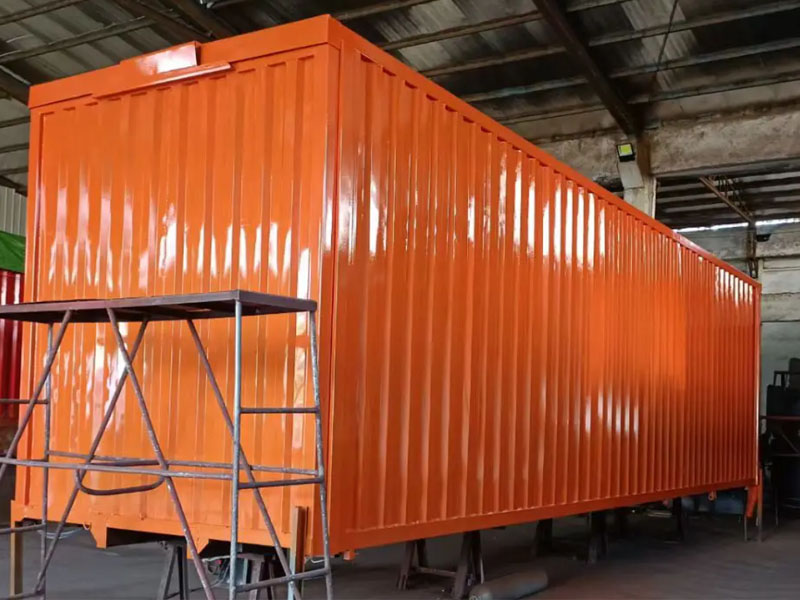
Trailers, semi-trailers, dump trucks, tanker trucks and other heavy-duty transport equipment operate under some of the most demanding conditions encountered by industrial coatings.
Unlike stationary indoor steel structures, these vehicles are continuously exposed to a combination of environmental and mechanical stresses.
A typical Heavy Duty Truck Coating may need to withstand:
- Rain and moisture
- Strong sunlight and UV radiation
- Road salts
- Stone impact
- Cargo abrasion
- Mechanical vibration
- Mud and dust
- Oil and fuel contamination
- Cleaning chemicals
- Temperature changes
This explains why some heavy-duty vehicles begin to show localized rust, blistering, peeling, gloss loss or fading after only a few years—or sometimes even earlier.
These defects appear on the surface, but the real cause often lies deeper within the design, application and durability of the complete protective coating system.
Understanding why coatings fail is therefore the first step toward designing better long-term corrosion protection.
1. Mechanical Impact and Abrasion Continuously Damage the Coating
A Heavy Duty Truck Coating does not operate in a static environment.
During everyday service, truck bodies, trailers and dump bodies can experience continuous mechanical stress from:
- Gravel and stone impact
- Cargo loading and unloading
- Tools and equipment
- Road debris
- Scratching
- Structural vibration
- Repeated movement and deformation
High-risk areas usually include:
Edges → Welds → Chassis Components → Lower Body Areas → Connection Points → Loading Areas
These areas are often the first places where coating damage becomes visible.
For this reason, hardness alone should never be used to evaluate the mechanical durability of a truck coating.
A coating can be extremely hard but still be brittle.
When repeated impact and vibration occur, a brittle film may develop microcracks, chipping or localized delamination.
A better Heavy Duty Truck Coating therefore requires a balance between:
Hardness + Flexibility + Adhesion + Impact Resistance
The coating needs to resist damage while still being able to accommodate a certain degree of substrate movement.
2. Why Can a Small Scratch Develop Into Serious Corrosion?
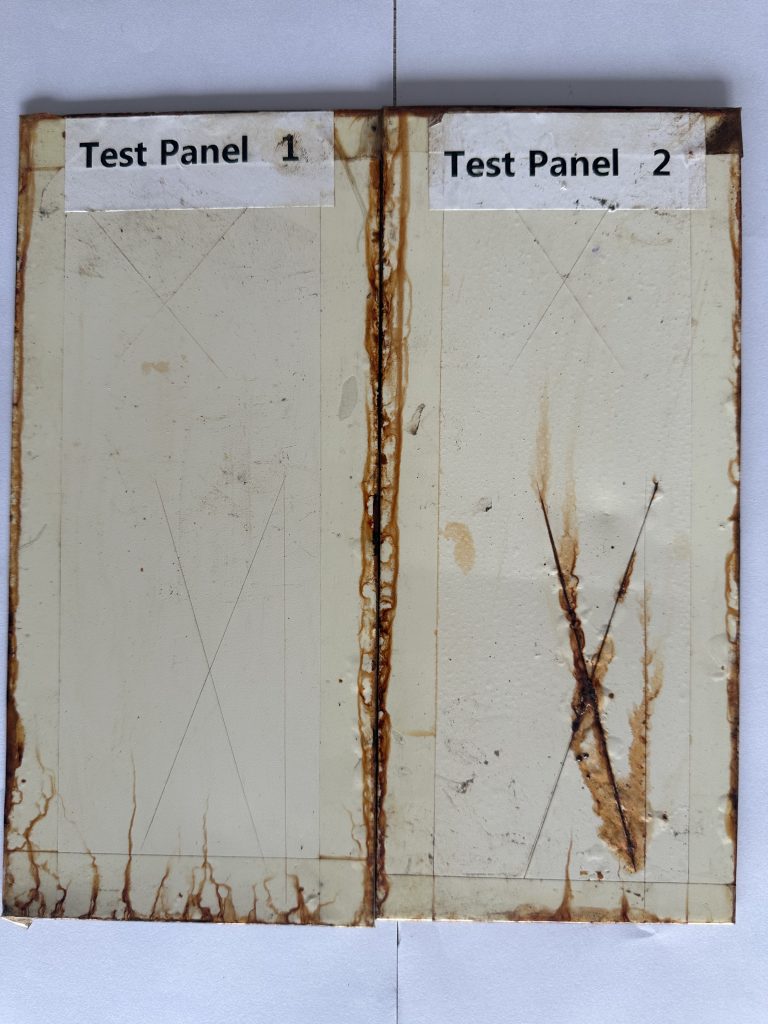
This is one of the most important mechanisms behind truck coating failure.
When a protective coating remains intact, it acts as a barrier between the steel and the surrounding environment.
The coating helps prevent:
- Water
- Oxygen
- Chlorides
- Road salts
- Other corrosive contaminants
from reaching the steel substrate.
However, consider what happens after a stone strikes the coating and creates a small defect.
The failure process may begin:
Mechanical Damage
↓
Steel Becomes Locally Exposed
↓
Water and Salts Reach the Substrate
↓
Corrosion Begins
↓
Corrosion Spreads Under the Coating
↓
Adhesion Decreases
↓
Blistering and Peeling Develop
↓
Larger Areas of Steel Become Exposed
What started as a small scratch can gradually become a much larger corrosion problem.
For heavy-duty transportation equipment, corrosion protection therefore needs to do more than prevent initial rust.
The complete system should also maintain adhesion and film integrity under mechanical and environmental stress.
Protective coating systems should be selected according to the actual corrosive environment and expected durability. The ISO 12944 protective coating standard provides internationally recognized guidance for corrosion protection of steel structures using protective paint systems.
3. Why Increasing DFT Alone Does Not Solve the Problem
Dry Film Thickness is an important parameter in corrosion protection.
But:
Thicker does not automatically mean more durable.
Increasing coating thickness can improve barrier protection within the appropriate specification.
However, simply using high-viscosity material and applying an excessively thick film does not automatically improve:
- Adhesion
- Flexibility
- Impact resistance
- Chemical resistance
- Long-term durability
Depending on the coating chemistry and application conditions, excessive film thickness may even contribute to problems such as internal stress, solvent retention, incomplete curing or cracking.
For a Heavy Duty Truck Coating, the objective should therefore be the correct DFT, not the maximum possible DFT.
A well-designed truck coating system needs to balance:
Adhesion
Flexibility
Impact Resistance
Barrier Protection
Water Resistance
Chemical Resistance
These properties work together to determine long-term performance.
4. Barrier Protection Is Critical to Truck Corrosion Resistance
One of the fundamental functions of an anti-corrosion coating is to slow the movement of corrosive species toward the steel substrate.
Heavy trucks repeatedly experience environmental cycles such as:
Rain → Drying → Humidity → Sunlight → Temperature Change → Rain Again
In coastal environments or regions where deicing salts are widely used, the challenge becomes even greater.
Water and chloride-containing contaminants may remain on:
- Chassis components
- Lower body areas
- Welds
- Corners
- Crevices
- Horizontal surfaces
A reliable Heavy Duty Truck Coating therefore needs more than strong adhesion.
It should also form an effective barrier against moisture and corrosive contaminants.
The coating formulation, film integrity and application quality all influence this barrier performance.
5. Water, Road Salt and Chlorides Accelerate Corrosion
Road environments can be particularly aggressive toward steel.
During winter operation in regions using deicing salts, trucks and trailers may repeatedly encounter chloride-containing water and road spray.
The combination of:
Moisture + Oxygen + Chlorides + Coating Damage
can significantly increase corrosion risk.
This is particularly important around areas already damaged by stone impact or abrasion.
If the coating has insufficient adhesion or barrier properties, corrosion can begin underneath the coating and spread beyond the original damaged area.
For this reason, salt spray resistance is useful when evaluating corrosion performance—but it should not be the only criterion.
Real vehicle durability also depends on:
- Surface preparation
- Adhesion
- Film integrity
- Mechanical durability
- DFT
- Water resistance
- Coating design
A laboratory salt spray number cannot represent all of these factors by itself.
6. Chemical Exposure Is Often Overlooked
Heavy-duty vehicles encounter more than water and salt.
Depending on the application, a trailer, tanker truck, dump truck or industrial vehicle may be exposed to:
- Fuel
- Lubricants
- Oil contamination
- Cleaning agents
- Industrial dust
- Road contaminants
- Mild acidic environments
- Mild alkaline environments
- Other chemicals
Repeated chemical exposure can gradually affect an unsuitable coating.
Possible symptoms include:
- Softening
- Swelling
- Discoloration
- Blistering
- Gloss loss
- Reduced adhesion
Therefore, chemical resistance should be considered when designing coatings for vehicles operating in industrial or particularly demanding environments.
The required resistance should always be matched to the actual chemicals and exposure conditions expected in service.
7. Why Does Truck Paint Fade and Lose Gloss?
Rust and peeling are not the only common forms of coating failure.
Heavy trucks and trailers remain outdoors for thousands of hours every year.
Their exterior surfaces continuously receive:
UV Radiation + Heat + Rain + Humidity + Atmospheric Contamination
If the topcoat has insufficient weather resistance, gradual degradation may result in:
- Fading
- Chalking
- Gloss loss
- Color change
- Surface deterioration
This is why the topcoat should not be considered merely a decorative color layer.
For long-term outdoor equipment, it performs an important protective function.
A high-performance Truck Topcoat should be designed with appropriate:
- UV resistance
- Weather resistance
- Color retention
- Gloss retention
- Water resistance
- Chemical resistance
For applications requiring long-term exterior appearance, a suitable weather-resistant topcoat can help protect both the appearance and integrity of the complete coating system.
8. Primer and Topcoat Need to Work Together
No individual coating layer can solve every problem.
For many land-based heavy-duty trucks, trailers and special-purpose vehicles, a practical system can be designed around:
High-Performance Epoxy Primer
The primer contributes:
- Adhesion to properly prepared steel
- Corrosion protection
- Barrier performance
- Water resistance
- Mechanical durability
↓
Weather-Resistant Truck Topcoat
The topcoat contributes:
- UV resistance
- Weather resistance
- Color retention
- Gloss retention
- Exterior durability
- Final appearance
This creates a relatively efficient two-coat system:
Epoxy Primer + Truck Topcoat
For more aggressive environments or project-specific durability requirements, additional layers or different primer technologies may be appropriate.
The coating system should therefore be selected according to the actual vehicle, substrate, operating environment and production requirements.
9. Surface Preparation Can Determine Whether the Coating Stays Attached
Even an excellent coating formulation cannot compensate for inadequate surface preparation.
Before applying a Heavy Duty Truck Coating, the steel may contain:
- Rust
- Mill scale
- Welding contamination
- Oil
- Grease
- Dust
- Moisture
- Salts
If these contaminants remain underneath the primer, coating adhesion and long-term corrosion protection can be compromised.
Proper preparation may include:
Degreasing → Rust Removal / Blasting → Dust Removal → Surface Inspection → Primer Application
The exact preparation method depends on the substrate, coating system and manufacturing process.
This is particularly important around welds, edges and complex frame structures where contamination and insufficient coating coverage are more likely.
10. Edges and Welds Need Special Attention
A vehicle is not a flat steel test panel.
Truck bodies and trailers contain:
- Welds
- Sharp edges
- Bolts
- Corners
- Brackets
- Frames
- Reinforcement structures
- Difficult-to-spray areas
These geometric features can make it more difficult to achieve uniform coating coverage.
Sharp edges in particular may receive a lower effective film build than surrounding flat surfaces.
This is why coating design and application quality should consider not only average DFT but also vulnerable structural details.
Depending on the specification, stripe coating or additional attention to edges and welds may help improve protection in critical areas.
11. Why Salt Spray Hours Alone Cannot Predict Truck Coating Life
A truck coating may achieve excellent results in a controlled salt spray test.
But the laboratory panel is not experiencing:
- Stone impact
- Cargo abrasion
- Chassis vibration
- Structural flexing
- UV radiation
- Road contamination
- Repeated washing
- Mechanical scratches
A truck operates under all of them.
Therefore, when evaluating a Heavy Duty Truck Coating, we should ask more than:
How many salt spray hours can it pass?
We should also ask:
How well does it adhere?
How does it behave under impact?
Is the coating sufficiently flexible?
Can it resist water and road contaminants?
Does the topcoat maintain color and gloss outdoors?
Can the complete coating system remain intact under real operating conditions?
These questions provide a much more realistic picture of long-term coating performance.
12. How GranBond Approaches Heavy Duty Truck Coating Development
At GranBond, our objective is not simply to increase paint viscosity or build an unnecessarily thick film to create the appearance of a “heavy-duty” coating.
For trailers, heavy trucks, dump trucks, tanker trucks and other industrial vehicles, coating performance needs to reflect the conditions these assets experience in real service.
Our development and testing therefore considers multiple performance characteristics, including:
- Adhesion
- Flexibility
- Impact resistance
- Barrier performance
- Water resistance
- Chemical resistance
- Salt spray resistance
- Weather resistance
- Film thickness
- Intercoat compatibility
- Application performance
The objective is to find an appropriate balance.
A protective coating needs to be strong enough to resist damage, but it should also maintain sufficient toughness and adhesion to survive long-term vibration, impact and environmental exposure.
Because for heavy-duty transportation equipment, coating performance should not be judged only by:
“How good does it look immediately after painting?”
The more important question is:
“How much protection can it still provide after years of real-world service?”
That is the principle behind GranBond’s continued development of protective coating systems for heavy-duty transportation equipment.
Frequently Asked Questions
What causes Heavy Duty Truck Coating to peel?
Poor surface preparation, contamination, inadequate adhesion, incorrect application, excessive film thickness, mechanical impact and unsuitable recoating conditions can all contribute to coating peeling.
Why do trailers rust around edges and welds first?
Edges, welds and complex structural areas are more difficult to coat uniformly and are often exposed to higher mechanical stress and moisture accumulation.
Is a thicker truck coating more corrosion resistant?
Not necessarily. Correct DFT is important, but adhesion, flexibility, barrier properties, curing and application quality also determine corrosion performance.
Why does truck paint fade outdoors?
UV radiation and long-term weather exposure can degrade unsuitable topcoats, resulting in fading, chalking and gloss loss.
What coating system is suitable for heavy trucks?
The appropriate system depends on substrate, environment and performance requirements. For many land-based heavy-duty vehicle applications, a properly selected epoxy primer + weather-resistant Truck Topcoat can provide a practical balance of corrosion protection, mechanical durability and appearance.
Is salt spray testing enough to evaluate truck coatings?
No. Salt spray testing provides useful corrosion-resistance information under controlled conditions, but vehicle coatings should also be evaluated for adhesion, impact resistance, flexibility, weather resistance and other relevant properties.
Conclusion
A successful Heavy Duty Truck Coating is not simply the hardest, thickest or highest salt-spray-rated paint.
Trailers, dump trucks, tanker trucks and heavy-duty vehicles experience a combination of:
Corrosion + Impact + Vibration + Water + Salt + Chemicals + UV Exposure
A reliable coating system therefore needs balanced performance.
The objective is to maintain:
Strong Adhesion
Mechanical Toughness
Barrier Protection
Water & Chemical Resistance
Outdoor Weather Resistance
When these properties work together, the coating is better equipped to maintain its integrity and protect the underlying steel throughout real-world service.
For heavy-duty transportation equipment, the true value of a coating is not measured only on the day it leaves the paint shop.
It is measured by how effectively it continues protecting the asset years later.